


IRMAA: The Medicare Surcharge Nobody Explained
What the Income-Related Monthly Adjustment Amount is, the 2026 income brackets, and why your FERS annuity, TSP withdrawals and Roth conversions all affect it.
Key takeaways
- IRMAA is an extra charge on your Medicare Part B premium, set by your income. In 2026 it starts above $109,000 (single) or $218,000 (joint).
- It looks back two years. Your 2026 premium is generally based on your 2024 tax return, so by the time you see the bill, that year’s income is already locked in.
- It’s a cliff, not a slope. Going $1 over a threshold can mean paying that bracket’s full surcharge for the year.
- Federal income adds up. FERS annuity, traditional TSP withdrawals, RMDs and Roth conversions all count.
- Retiring can qualify as a “life-changing event.” Form SSA-44 lets you ask Social Security to use your lower, more recent income.
In this article
- What is IRMAA?
- 2026 IRMAA brackets
- The two-year lookback
- What counts for federal retirees
- RMDs, Roth conversions & IRMAA
- How to appeal: SSA-44
- FAQ
A woman joined a Zoom call with Charles holding a legal pad. Across the top she had written one word, a government acronym she’d first heard about a week earlier, and underlined it twice.
The word was IRMAA.
She had worked in federal service for 31 years. On Episode 122 of the CD Financial Podcast, “Two Worries,” Charles says her situation wasn’t unusual. It was typical. Taxes are one of the two worries he hears in nearly every conversation with federal employees close to retirement, and IRMAA is the part of that worry most people have never heard of until it shows up.
Nobody explained any of this to me.
A federal employee with 31 years of service, as recounted on the CD Financial Podcast, EP. 122
What is IRMAA?
IRMAA stands for Income-Related Monthly Adjustment Amount. It’s an extra amount added to your Medicare Part B premium when your income is above certain levels.
Social Security decides whether you owe it using your modified adjusted gross income (MAGI) from your federal tax return. For IRMAA, that means your adjusted gross income plus any tax-exempt interest. Medicare then adds the surcharge to your premium. It is charged per person, so a married couple who are both on Part B may each pay it.
- $202.90: Standard 2026 Part B premium per month
- $109K: Single-filer income where IRMAA begins ($218K joint)
- $689.90: Highest 2026 Part B premium per month
2026 IRMAA brackets for Medicare Part B
These are the official 2026 amounts from CMS. They’re generally based on your 2024 tax return.
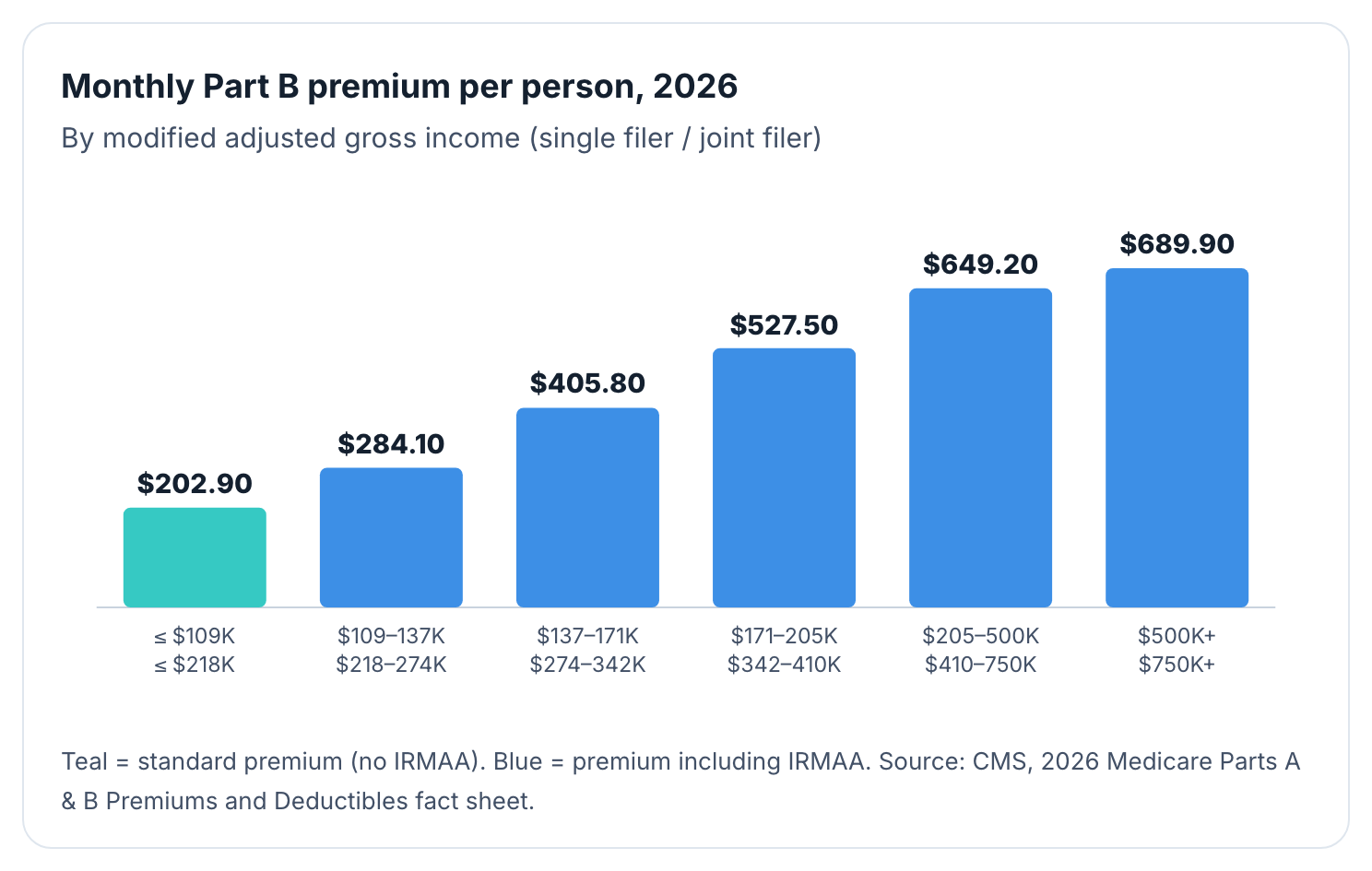
| Single filer MAGI | Joint filer MAGI | IRMAA / mo | Total Part B / mo |
|---|---|---|---|
| $109,000 or less | $218,000 or less | $0.00 | $202.90 |
| $109,001 – $137,000 | $218,001 – $274,000 | $81.20 | $284.10 |
| $137,001 – $171,000 | $274,001 – $342,000 | $202.90 | $405.80 |
| $171,001 – $205,000 | $342,001 – $410,000 | $324.60 | $527.50 |
| $205,001 – $499,999 | $410,001 – $749,999 | $446.30 | $649.20 |
| $500,000 or more | $750,000 or more | $487.00 | $689.90 |
Married filing separately and lived with spouse: $202.90 at $109,000 or less; $649.20 above $109,000 and under $391,000; $689.90 at $391,000 or more.
Looking ahead to 2027: CMS usually announces next year’s premiums and brackets in the fall. As of this writing, the 2027 figures have not been released. They’ll generally be based on your 2025 tax return, so that income is already set. We’ll update this page when CMS publishes them.
The cliff effect
IRMAA brackets don’t phase in gradually. If your MAGI is $1 over a threshold, you generally pay that bracket’s full surcharge for the year. For a single filer just over $109,000 in 2026, that’s $81.20 more a month for Part B, about $974 for the year. If both spouses are on Medicare, double it.
The two-year lookback (the “echo”)
On the podcast, Charles calls this the echo. Your premium this year is set by what you earned two years ago. It explains why so many people are caught off guard:
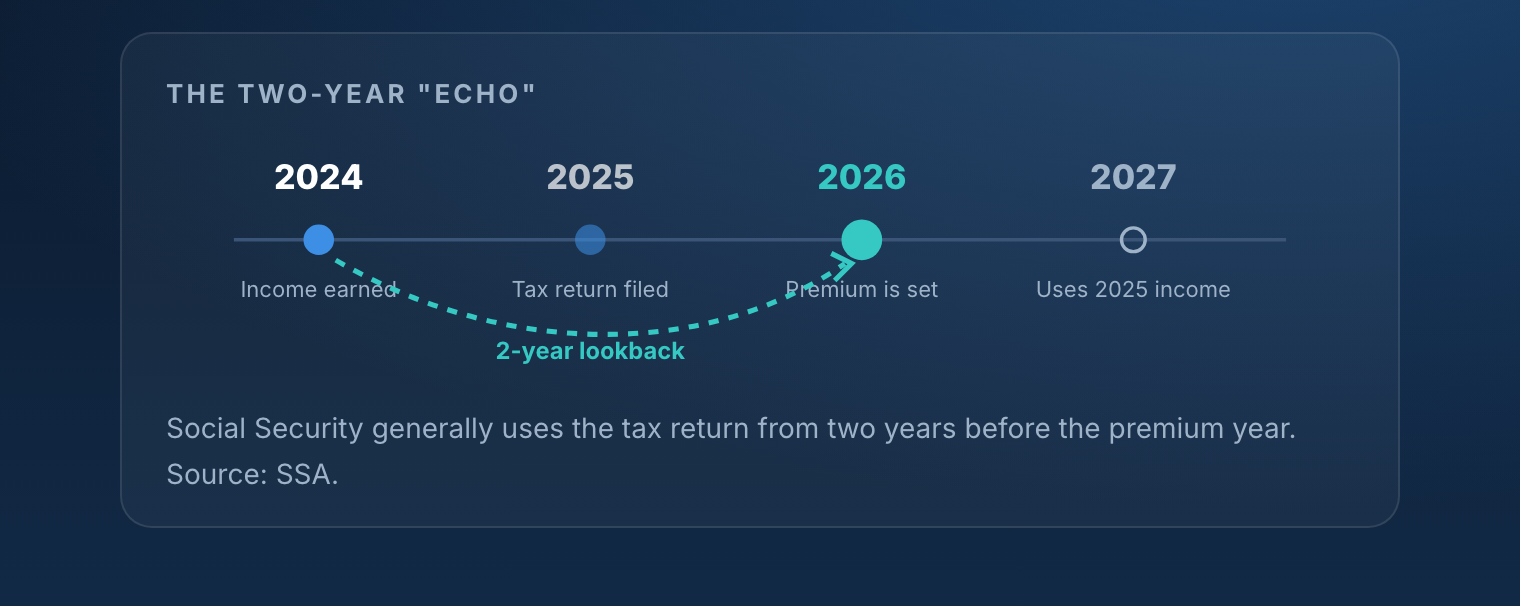
- You find out after the fact. When the notice from Social Security arrives, the income that triggered it is already on a tax return you’ve filed.
- Your final working years can follow you. A year with a full salary, a lump-sum annual leave payout or a large TSP withdrawal can set your premium for a year in which your income is much lower.
- Planning has to start early. Decisions you make at 63 can affect your premium at 65.
What counts toward IRMAA for federal retirees
The income you earned over a federal career can add up in retirement, often more than people expect.
Counts
- FERS or CSRS annuity. The taxable portion of your pension counts toward MAGI.
- Traditional TSP and IRA withdrawals. Includes required minimum distributions (RMDs).
- Roth conversions. The converted amount is taxable income in the year you convert.
- Taxable Social Security, interest and capital gains. Tax-exempt municipal bond interest is added back for IRMAA too.
Generally doesn’t count
- Qualified Roth TSP and Roth IRA withdrawals. Qualified Roth distributions aren’t included in AGI.
- Qualified charitable distributions. QCDs from an IRA after age 70½ go directly to charity and are excluded from AGI.
FEHB and Medicare: IRMAA applies only if you’re enrolled in Medicare Part B. Many federal retirees weigh whether to pair FEHB with Part B. If you’re a Postal Service annuitant in PSHB, Part B enrollment is generally required. Either way, it’s worth knowing your IRMAA exposure before you decide.
RMDs, Roth conversions and IRMAA
This is where Charles’s first worry, taxes, meets IRMAA. In the episode he describes what lands on people who saved diligently their whole careers: at a certain age, the government starts telling them how much they have to withdraw from their TSP or IRA, and that amount can rise each year.
The reward for being disciplined is a bill you can’t say no to.
Marcus, CD Financial Podcast, EP. 122
Required minimum distributions
Under current law, RMDs from traditional TSP and IRA balances generally begin at age 73 (75 for people born in 1960 or later). Each RMD is taxable income, so it can raise MAGI and, two years later, your Medicare premium. Since 2024, Roth TSP balances are no longer subject to RMDs while you’re alive.
Roth conversions
Converting traditional dollars to Roth can reduce future RMDs and the taxable income your heirs inherit, which was another worry raised in the episode. But the year you convert, your MAGI goes up. Some people spread conversions over several years to stay below a given bracket. Whether that makes sense depends on your tax bracket, timing, health coverage and estate goals, so look at it with a professional who can see your whole picture.
How to appeal IRMAA: Form SSA-44
If your income has dropped because of a qualifying life-changing event, you can ask Social Security to use a more recent year’s income instead. For many federal employees, retirement itself counts as a work stoppage.
Qualifying life-changing events on Form SSA-44 include:
- Marriage, divorce or annulment, or the death of a spouse
- Work stoppage or work reduction (such as retiring or reducing hours)
- Loss of income-producing property, or loss or reduction of certain pension income
- An employer settlement payment
- Read your IRMAA notice. It shows the tax year and the income Social Security used.
- Complete Form SSA-44. Choose the event and its date, then estimate your reduced MAGI for the relevant year.
- Attach evidence. For example, an agency letter or SF-50 confirming your retirement date, or a signed statement if allowed.
- Submit it to Social Security. Mail or fax it to your local office, or call 1-800-772-1213 to request an appointment.
If the IRS data Social Security used was wrong, or you filed an amended return, you can ask for a new determination with the corrected information.
IRMAA FAQ
What is IRMAA?
IRMAA, the Income-Related Monthly Adjustment Amount, is an extra amount added to Medicare Part B premiums when your MAGI is above certain thresholds. In 2026 it starts above $109,000 for individual filers and $218,000 for joint filers.
What year’s income is used for 2026 IRMAA?
Generally your 2024 federal tax return, two years earlier. If that return isn’t available, Social Security may use the return from three years earlier and adjust once the newer return is on file.
Does my FERS annuity count toward IRMAA?
Yes. Taxable FERS or CSRS annuity payments are part of AGI. Traditional TSP withdrawals, RMDs and Roth conversions also count.
Can I appeal IRMAA after I retire?
If your income dropped because of a life-changing event, such as work stoppage, work reduction, marriage, divorce, death of a spouse or loss of pension income, you can file Form SSA-44 with evidence and ask Social Security to use a more recent year.
Do Roth conversions affect IRMAA?
Yes, in the year you convert. The converted amount raises MAGI and can affect your premium two years later. Qualified Roth withdrawals later generally don’t count toward MAGI.
Is IRMAA per person or per household?
Per person. A married couple filing jointly who are both enrolled in Part B would each pay the surcharge for their bracket.
Have a legal pad full of questions?
Talk with CD Financial about how your FERS, TSP and Medicare decisions fit together, before the calendar decides for you. Text 949-359-5100.
Sources
- Centers for Medicare & Medicaid Services, 2026 Medicare Parts A & B Premiums and Deductibles (Nov. 14, 2025).
- Social Security Administration, Premiums: Rules for Higher-Income Beneficiaries.
- Social Security Administration, Request to Lower an Income-Related Monthly Adjustment Amount, and Form SSA-44.
- CD Financial Podcast, EP. 122, “Two Worries.”
Important information. CD Financial is a registered investment adviser. Registration does not imply a certain level of skill or training. Investing involves risk, including the potential loss of principal. No investment strategy can guarantee a profit or protect against loss in periods of declining values. None of the information contained on this website shall constitute an offer to sell or solicit any offer to buy a security or any insurance product. This content is for informational purposes only and is not investment, tax, or legal advice. Medicare premium and IRMAA figures are for 2026 as published by CMS and may change. Rules for required minimum distributions, Roth conversions and Medicare are subject to change. Client names and details in podcast stories have been changed. Consult a qualified tax professional about your situation.
Schedule Your Complimentary Call
Text your Name & Email to 949.359.5100 Or Schedule Below