


How Much Do You Really Need in the TSP to Retire? The 4 TSP Tiers
We follow a hypothetical FERS employee through four TSP balances, $775K, $1M, $2M and $3M, to show what each tier could pay, what can go wrong, and why your pension changes the math.
We follow a hypothetical FERS employee through four TSP balances, $775K, $1M, $2M and $3M, to show what each tier could pay, what can go wrong, and why your pension changes the math.
Key takeaways
- Your pension changes the math. Most “you need $2 million” headlines were written for people without one.
- In our hypothetical example, a FERS pension and Social Security cover $57,000 a year before the TSP pays a dollar.
- Each tier changes the question. At $775K it’s “can I handle surprises?” At $1M it’s “when?” At $2M and $3M it’s taxes, RMDs and legacy.
- Moving up a tier is often about contributions and staying invested, especially catch-up contributions after 50.
- Know your own numbers: your pension estimate, your Social Security estimate and your TSP contribution rate.
In this article
- Meet Fran
- Your pension changes the math
- The 4% rule
- The four TSP tiers
- How to move up a tier
- What makes the tiers look worse or better
- Listener questions
- FAQ
Ask a hundred federal employees how much they need in the TSP to retire and you’ll hear a million, two million, or “more than I’ve got.” On Episodes 124 and 125 of the CD Financial Podcast, Charles explains why many of them may be using math that was built for people who don’t have a pension.
They might be using math that was built for people who don’t have a pension.
Charles Dzama, CD Financial Podcast, EP. 124
Meet Fran (a hypothetical example)
To make the tiers concrete, we follow one hypothetical federal employee. Fran isn’t a real client; her numbers are simplified for illustration.
- Age today: 52
- Retirement system: FERS
- TSP balance: $775,000
- Plans to retire at: 62, with 30 years of service
- High-3 salary: $100,000
Your pension changes the math
Why 62 matters
Under FERS, if you retire at 62 or older with at least 20 years of service, your pension multiplier rises from 1.0% to 1.1%. For Fran, that’s the difference between $30,000 and $33,000 a year ($100,000 high-3 × 30 years × 1.1%), about $250 more a month, with cost-of-living adjustments starting at 62.
Income before the TSP
Add a Social Security estimate (we use $24,000 a year as an example; yours depends on your earnings record, so pull your own at ssa.gov) and Fran has about $57,000 a year coming in before she touches her TSP.
- $33,000: FERS pension a year at 62 (hypothetical)
- $24,000: Social Security a year (example estimate)
- $57,000: yearly income before any TSP withdrawal
What’s the pension “worth”?
One simple way to see it: to pull $33,000 a year from savings at a 4% withdrawal rate, you’d need about $825,000. Next to her $775K TSP, Fran is sitting on the equivalent of roughly $1.6 million in retirement resources. Charles estimates a private-sector worker might pay $750,000 to $900,000 for similar lifetime income, depending on pension size, age and annuity rates.
Hypothetical, simplified math. A pension is not an account balance and can’t be withdrawn as a lump sum.
The 4% rule, in plain English
The 4% rule is a rule of thumb from retirement research: take out about 4% of your balance in your first year of retirement, then adjust for inflation. Historically, a balanced portfolio has often lasted 30 years or longer. It’s a starting point, not a law and not a promise. Some retirees may be able to draw more, others less.
For feds it can work in your favor: when a pension and Social Security cover the basics, your TSP isn’t carrying everything, so a bad market year may hurt less than it would for someone relying only on a 401(k) and Social Security. Charles calls the pension a shock absorber.
Based on retirement research (Bengen, 1994). Past performance does not guarantee future results.
The four TSP tiers (hypothetical)
Here’s what Fran’s yearly income could look like at each TSP balance if she retires at 62, using a 4% first-year withdrawal plus her $57,000 pension and Social Security.
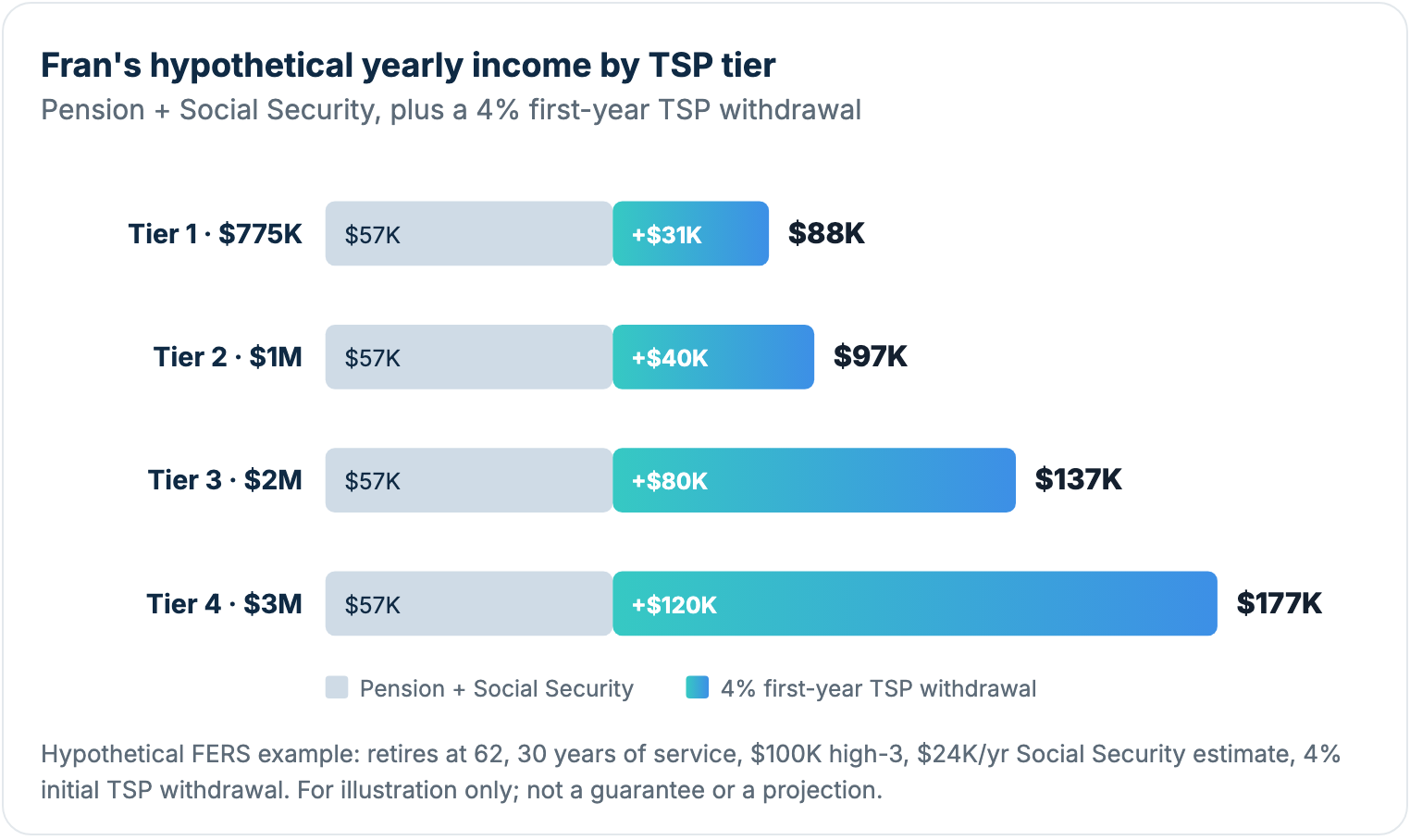
| Tier (retiring at 62) | TSP at 4% | Pension + SS | Total / yr |
|---|---|---|---|
| Tier 1 · $775K (Fran today) | $31,000 | $57,000 | $88,000 |
| Tier 2 · $1 million | $40,000 | $57,000 | $97,000 |
| Tier 3 · $2 million | $80,000 | $57,000 | $137,000 |
| Tier 4 · $3 million | $120,000 | $57,000 | $177,000 |
Hypothetical FERS example: retires at 62, 30 years of service, $100K high-3, $24K/yr Social Security estimate, 4% initial TSP withdrawal. Retiring earlier, such as at her MRA of 57, would mean a smaller pension (no 1.1% multiplier) and the FERS supplement instead of Social Security until 62, so these totals would not apply. Hypothetical illustration for educational purposes only. It does not represent any actual client or investment, is not guaranteed, and does not reflect fees, expenses or taxes. Actual results will vary.
Tier 1: $775K, where Fran is today
On paper, $88,000 is a pay cut from $100,000. But several costs stop at retirement: she’s no longer putting 10–15% into the TSP, no longer paying Social Security and Medicare tax on wages, and may not be commuting or buying work lunches. Many people at this tier may be able to travel a little, help family and still sleep at night. If the mortgage is paid off, this tier can feel a lot like the next one.
The risks: big surprises, like a $30,000–$45,000 roof, a new car or helping the kids, can push your withdrawal rate up. Health care is the other one: FEHB premiums have risen by double digits in recent years.
Moves that may help: keep an emergency fund outside the TSP so a surprise doesn’t force a withdrawal in a down market, and think about Social Security timing. Each year you wait from full retirement age (67 or less, depending on your birth year) to 70, your benefit grows by 8%.
Tier 2: $1 million, the TSP Millionaire Club
It’s a bigger club than most people think, and many members are GS-12s, 13s and 14s who started early and stayed consistent. At this tier the question shifts from “can I retire?” to “when do I want to retire?”
Fran might consider retiring at her minimum retirement age (MRA), say 57 with 30 years of service. She’d get an immediate pension with no penalty, but at the 1.0% multiplier, not 1.1%. She’d also get the FERS supplement, a bridge payment until 62, though an earnings test means a new job can reduce or stop it. Leaving early can work at this tier; it just has to be purposeful. Keep in mind that the tier figures above assume she retires at 62; at 57 her pension would be smaller and the $57,000 base wouldn’t apply until Social Security begins.
The trap: getting too conservative. A 10% drop on $100,000 is $10,000; on $1 million it’s $100,000. Same math, bigger number. If Fran lives to 87 or beyond, money that doesn’t outpace inflation is like a slow leak. A common approach is to separate the money: several years of planned withdrawals in more stable funds, and long-term money that stays invested.
General illustration, not a recommendation. Diversification does not guarantee a profit or protect against loss.
Tier 3: $2 million, options
A 4% withdrawal now means about $80,000 from the TSP and $137,000 a year in total. That can mean real trips, helping kids with a down payment or grandkids with college, and flexibility, like delaying Social Security to 70 and living on savings in the meantime. The 4% rule is a starting point; some retirees at this level may be able to draw more, and that depends on the plan.
It’s not what you make. It’s what you keep.
Charles Dzama, CD Financial Podcast, EP. 124
Taxes become the main event. The FERS pension is taxable, traditional TSP withdrawals are taxable, and up to 85% of Social Security can be taxable. The question becomes which bucket to draw from. Qualified Roth TSP withdrawals are tax-free, and the years between retiring and claiming Social Security can be a window to convert some traditional money to Roth at a lower rate. That’s specific to each household, so run the numbers first.
Sources: IRS Publication 915 and Publication 721; TSP.gov. Roth conversions are taxable; consult a tax professional.
Tier 4: $3 million, planning beyond income
Is $3 million realistic for a fed? It’s less common, but Charles has seen it, often when both spouses’ accounts are counted together. At this tier a 4% withdrawal is about $120,000, and Fran probably won’t spend it all. What’s left to plan is everything else:
- Required minimum distributions. RMDs generally start at 73 (born 1951–1959) or 75 (born 1960 or later). On a large balance they can push you into a higher tax bracket and raise your Medicare premiums through IRMAA.
- Beneficiaries. TSP beneficiary designations override your will. Check them after every life change.
- Survivor benefits. If Fran is married, a full survivor benefit reduces her pension by 10% and provides her spouse 50%; a partial benefit reduces it by 5% and provides 25%. Electing at least some survivor benefit lets a surviving spouse keep FEHB coverage, and the choice is hard to undo after retirement.
Sources: IRS Publication 590-B; TSP.gov (Form TSP-3); OPM (FERS survivor benefits).
How Fran could move up a tier (hypothetical)
Fran has 10 years until 62. Starting from her $775,000, here’s how one decision, her contribution rate, could change where she lands, using two hypothetical average annual returns, 4% and 7%.
| Scenario (10 years) | Added per year | At 4% a year | At 7% a year |
|---|---|---|---|
| Keeps contributing 5% + 5% agency match | $10,000 | ≈ $1.27M | ≈ $1.66M |
| Maxes out: $24,500 + $8,000 catch-up + $5,000 match | $37,500 | ≈ $1.60M | ≈ $2.0M |
Assumes a $775,000 starting balance, a constant 4% or 7% average annual return, contributions at the end of each year and 2026 IRS contribution limits. Real returns are not steady from year to year and can be negative. Hypothetical illustration for educational purposes only. It does not represent any actual client or investment, is not guaranteed, and does not reflect fees, expenses or taxes. Actual results will vary.
Two things to keep in mind. First, a dollar in 10 years won’t buy what it buys today, so adjust for inflation when you picture a future balance. Second, the catch-up rules changed: for 2026, the catch-up is $8,000 at 50 and older and $11,250 at ages 60 to 63. If your wages were over $150,000 the year before, your catch-up must go to Roth.
Why staying invested may matter. In Charles’s experience, people who reach a million in the TSP rarely got there by jumping in and out of the G Fund every time markets got scary. Within roughly three to five years of retirement, it may make sense to start taking some risk off the table, because there’s less time to recover from a loss.
General information, not a recommendation. Past performance does not guarantee future results.
What can make the tiers look worse, or better
Watch for these
- Retiring before 62 without 30 years: you may lose the supplement and the higher multiplier.
- FEHB premiums keep rising, and you need 5 years of coverage before retiring to keep it.
- The FERS COLA trails inflation and, for most, starts at 62.
- A bad market early in retirement (sequence-of-returns risk).
- Taxes: plan every year, not just at retirement.
Boosters
- Unused sick leave counts toward service in the pension math.
- Reservists can buy back active-duty military years.
- A Social Security plan, especially for married couples and widows or widowers.
- A paid-off home can make Tier 1 feel like Tier 2.
Sources: OPM (FERS supplement, FEHB, COLA, sick leave credit, military deposits); SSA.
Listener questions
“I’m 56 with about $800,000 in my TSP. Can I retire at my MRA instead of waiting for 62?”
Maybe. You’d give up the 1.1% multiplier and live on the FERS supplement, with no COLA on the pension until 62, and you may need to draw from the TSP before Social Security. You’d also stop contributing. For many people at this level it could work, but map it out first.
“Should I be all in the G Fund now that I’m close to retirement?”
Charles doesn’t think going all in is likely to serve most people well. The G Fund can be part of your stable money, but all in can leave savings struggling to keep up with inflation. A common approach is to hold a few years of withdrawals in safer funds and stay diversified, based on your timeline, income needs and risk tolerance.
“Traditional or Roth TSP?”
Both can work. Roth often fits early in a career when your tax rate is lower; traditional can help in high-earning years. Many people end up with a combination, which gives them options in retirement.
Watch Part 2: EP. 125, “$3M in the TSP? What changes” on YouTube.
Your homework: four things this week
- Know your pension. High-3 × years of service × 1% (or 1.1% at 62 with 20+ years).
- Pull your Social Security estimate. Create or sign in to your account at ssa.gov.
- Check your TSP contribution rate. If you’re 50 or older, consider whether catch-up contributions fit your plan.
- Figure out your tier. If you’re within three to five years of retirement, get a written plan from someone who knows federal benefits.
FAQ
How much do I need in my TSP to retire as a federal employee?
There is no single number. A FERS pension and Social Security can cover a large share of your basic expenses, so many federal employees need less in the TSP than headlines written for people without a pension suggest. Your number depends on your pension, Social Security, spending, taxes and timing.
What is the 4% rule?
It is a rule of thumb from retirement research: withdraw about 4% of your balance in the first year of retirement and adjust for inflation after that. Historically, a balanced portfolio has often lasted 30 years or more. It is a starting point, not a promise.
Why does retiring at 62 matter under FERS?
If you retire at 62 or older with at least 20 years of service, your FERS pension multiplier rises from 1.0% to 1.1%, about a 10% larger pension for the same high-3 and years of service.
What are the 2026 TSP contribution limits?
For 2026 the employee limit is $24,500. Participants 50 and older can add an $8,000 catch-up, and those aged 60 to 63 can add $11,250 instead. If your wages were over $150,000 the prior year, catch-up contributions must go to Roth.
Should I move everything to the G Fund before I retire?
The G Fund can be one source of stable money, but going all in can leave your savings struggling to keep up with inflation over a long retirement. A common approach is to keep a few years of planned withdrawals in more stable funds and leave long-term money invested. Your mix depends on your timeline, income needs and risk tolerance.
Do TSP beneficiary designations override my will?
Yes. The person named on your TSP beneficiary designation (Form TSP-3) receives the account directly, regardless of what your will says. Review your designations after any major life change.
Find your tier
We’ll weave your pension, Social Security and TSP together and show you where you stand. Book a complimentary 15-minute call with Charles or text 949-359-5100.
Sources
- U.S. Office of Personnel Management, FERS computation and types of retirement.
- Social Security Administration, Delayed retirement credits.
- Internal Revenue Service, 2026 contribution limits; Publications 915, 721 and 590-B.
- Thrift Savings Plan, TSP.gov (Roth TSP, Form TSP-3).
- William P. Bengen, “Determining Withdrawal Rates Using Historical Data,” Journal of Financial Planning (1994).
- CD Financial Podcast, EP. 124 and EP. 125, “The TSP Tiers.”
Important information. CD Financial is a registered investment adviser. Registration does not imply a certain level of skill or training. Investing involves risk, including the potential loss of principal. No investment strategy can guarantee a profit or protect against loss in periods of declining values. None of the information contained on this website shall constitute an offer to sell or solicit any offer to buy a security or any insurance product. Insurance products and services are offered through CD Financial & Insurance Services, LLC, an affiliated company. Charles Dzama is a licensed insurance agent and may earn commissions on the sale of insurance products, including annuities. This content is for informational purposes only and is not investment, tax, or legal advice. CD Financial is not affiliated with OPM, the Social Security Administration, the Thrift Savings Plan or any other federal agency. “Fran” is a hypothetical example; all figures are illustrations, not projections or guarantees. Figures and limits are as of October 2026 and may change. Past performance does not guarantee future results.
Schedule Your Complimentary Call
Text your Name & Email to 949.359.5100 Or Schedule Below